How to Stop Thyroid Hair Loss: Causes, Treatments & Recovery Tips
Treatments & Recovery Tips You wash your hair and notice more strands than usual clinging to your fingers. Your scalp feels thinner, somehow. And you already know your thyroid hasn’t been behaving. If this sounds familiar, you’re not alone, and more importantly, you are not overreacting. Thyroid-related hair loss is one of the most common and most overlooked symptoms of thyroid imbalance. Whether your thyroid is underactive (hypothyroidism) or overactive (hyperthyroidism), the hormonal disruption it causes can quietly push your hair into a prolonged shedding phase. It shows up gradually, all over the scalp, which makes it easy to dismiss until it becomes hard to ignore. The reassuring part? In most cases, thyroid hair loss is reversible. Once the root cause is identified and treated, hair can and does come back. But knowing how to stop thyroid hair loss and actually doing it takes the right information, the right tests, and often a little patience with your body. This guide covers everything you need to know: what’s actually happening to your hair, how to support regrowth naturally, what medical treatment looks like, and a realistic timeline for what to expect. Not sure if thyroid is the only cause? This complete guide covers all major hair loss types and natural regrowth strategies.


Dr. Radhika Barde
M.B.B.S, DCH, DDV, FAD
Is Thyroid Hair Loss Normal?
Yes and it’s more common than most people realise. Hair loss is consistently ranked among the top reported symptoms in people with both hypothyroidism and hyperthyroidism. Yet it often gets brushed off or attributed to stress, seasonal changes, or age.
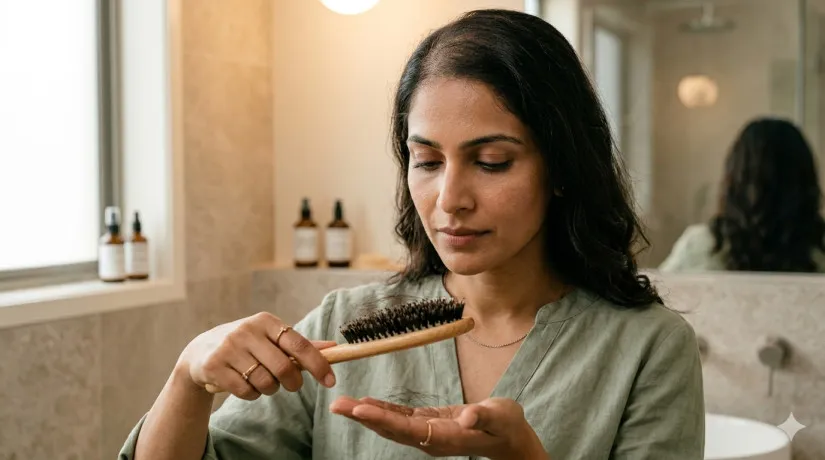
The reason thyroid conditions affect hair so directly is that thyroid hormones primarily T3 (triiodothyronine) and T4 (thyroxine) play a central role in regulating the hair follicle growth cycle. When these hormone levels go out of balance, the follicles can’t maintain their normal rhythm, and hair starts shedding faster than it’s being replaced.
This kind of hair loss is called telogen effluvium a diffuse, all-over thinning rather than patchy bald spots. It usually appears several weeks or even months after the thyroid imbalance begins, which is why the connection can be hard to spot at first. Understanding this mechanism is the first step toward knowing how to stop thyroid hair shedding effectively.Read: How to Stop Hair Loss and Regrow Hair Naturally
Elegance inYour Inbox
Join our curated circle and get 10% OFF on your first visit. Receive medical-grade insights, seasonal trends, and early access.
How Hypothyroidism and Hyperthyroidism Cause Hair Loss
Both an underactive and overactive thyroid can lead to hair loss, though the mechanisms differ slightly. Here’s what’s happening in each case:
Hypothyroidism (Underactive Thyroid)
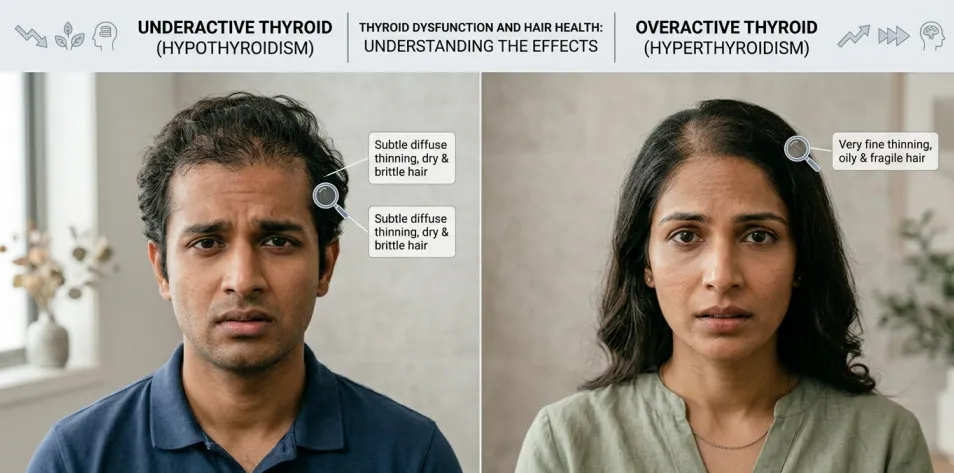
When the thyroid produces too little hormone, the body’s metabolism slows down and so does everything dependent on it, including hair growth. Hair follicles move into a prolonged resting phase, and new growth slows to a crawl.
What you typically notice:
- Diffuse thinning across the scalp
- Hair that feels dry, coarse, or brittle
- Increased shedding during washing or brushing
- In some cases, thinning of the outer third of the eyebrows
The hair loss in hypothyroidism tends to be gradual which means it can worsen significantly before it's connected to thyroid function. This is one of the main reasons people delay seeking help for thyroid hair fall.
Hyperthyroidism (Overactive Thyroid)
An overactive thyroid produces too much hormone, which speeds up the body’s processes including the hair cycle. This sounds counterintuitive (wouldn’t faster be better for hair growth?), but the follicles actually burn through their growth phase too quickly, leading to premature shedding.
What you typically notice:
- Generalised hair thinning that happens relatively quickly
- Hair that feels fine-textured or limp
- Shedding that seems disproportionate to what you’re used to
Hair Cycle Disruption: Why the Shedding Spreads
Both conditions push hair follicles into the resting and shedding phase of the hair cycle earlier than normal. Because this affects follicles across the entire scalp rather than in one area, the result is widespread thinning rather than a defined bald patch.
This diffuse pattern is actually a useful clue. If your hair loss is all over, and you have a known or suspected thyroid issue, there's a strong chance the two are connected and that learning how to stop thyroid hair thinning starts with getting your hormones properly assessed.
How to Identify Thyroid-Related Hair Loss
Thyroid hair loss doesn’t look the same as genetic hair loss or alopecia. Here are some signs that your thyroid may be the underlying cause:
- Diffuse, all-over thinning rather than a receding hairline or patchy loss
- Hair loss that developed alongside other thyroid symptoms fatigue, weight changes, sensitivity to temperature, mood shifts
- Shedding that worsened after a period of thyroid fluctuation or a change in medication
- Hair that looks and feels different in texture drier, finer, or more brittle than before
- Loss started a few weeks to months after thyroid symptoms began (this delay is very typical)
A blood test checking TSH, T3, and T4 levels along with ferritin (iron storage) is usually the first step in confirming thyroid-related hair loss. If you haven’t had these checked yet, that’s the place to start.
Other conditions can cause hair loss that looks similar to thyroid-related shedding. Before assuming thyroid is the sole cause, consider:
How to Stop PCOS Hair Loss: If you have irregular periods, acne, or insulin resistance alongside hair loss, PCOS may be a contributing factor.
Postpartum Hair Loss Guide: If hair loss began within a year of delivery, postpartum telogen effluvium may be overlapping with thyroid-related shedding.
How Long Do Iron Tablets Take to Stop Hair Loss? : Low ferritin independently causes diffuse shedding and often coexists with thyroid dysfunction.
Tip: Don’t stop at the thyroid panel. Ask your doctor to check ferritin levels too. Low iron is extremely common alongside thyroid disorders and independently causes hair shedding addressing both together makes a significant difference to recovery.
Not sure whether your hair loss is thyroid-related or something else? Getting the right diagnosis is the first step.Book Appointment for a personalised hair and thyroid assessment and get 10% off on your first consultation.
Diet, Nutrients & Natural Support for Thyroid Hair Regrowth
Medical treatment addresses the root cause, but nutrition and lifestyle play a meaningful supporting role. Several nutrient deficiencies are strongly linked to both thyroid dysfunction and hair loss; correcting them can make a real difference to how quickly hair recovers.

Key Nutrients for Thyroid and Hair Health
Iron (Ferritin)
Low ferritin is one of the most common and underappreciated triggers for hair shedding. Iron is needed for oxygen delivery to the hair follicle without adequate levels, the follicle can’t sustain normal growth. Ferritin levels below 30 ng/mL are often associated with hair thinning, even in the absence of clinical anemia.
Good dietary sources: spinach, lentils, chickpeas, red meat, fortified cereals.
Read more: Iron Deficiency Hair Loss Causes, Signs & What to Do
Selenium
Selenium is essential for converting the inactive thyroid hormone T4 into the active form T3, a process that happens primarily in the liver and kidneys. Without adequate selenium, thyroid function suffers even when the gland itself is working correctly. Selenium is also an antioxidant that supports follicle health.
Good dietary sources: Brazil nuts, sunflower seeds, tuna, eggs.
Zinc
Zinc supports hair follicle repair and is involved in the protein synthesis that hair growth depends on. Deficiency is linked to increased shedding and slower regrowth. It also plays a role in regulating thyroid hormone metabolism.
Good dietary sources: pumpkin seeds, whole grains, legumes, nuts.
Protein
Hair is made primarily of keratin, a structural protein. Without adequate dietary protein, the body deprioritises hair growth in favour of more essential functions. If your protein intake is low common in restrictive diets this alone can significantly slow regrowth even while thyroid treatment is underway.
Good sources: eggs, dairy, lentils, tofu, chicken, fish.
Important note: Deficiencies in iron, selenium, and zinc are commonly found alongside thyroid disorders and each one independently contributes to hair loss. Correcting these deficiencies while treating your thyroid gives your hair the best chance of recovering fully.
Eating for Your Thyroid and Hair
A balanced, nutrient-rich diet is the foundation. No single food or supplement will undo a thyroid imbalance but consistently eating well ensures your body has what it needs to support both hormone function and follicle recovery.
Focus on:
- Plenty of vegetables, especially leafy greens
- Lean proteins at most meals
- Selenium-rich foods a few times a week
- Zinc from whole grains, seeds, and legumes
- Iron-rich foods paired with vitamin C to improve absorption
Avoid:
- Crash diets or severe calorie restriction these worsen shedding
- Over-supplementing iodine without medical guidance this can actually aggravate thyroid conditions
- High-dose supplements without testing, especially iron and selenium
Managing Stress
Chronic stress raises cortisol levels, which in turn suppresses thyroid function and pushes hair follicles into the shedding phase, a double blow when you’re already dealing with thyroid-related hair loss.
This doesn’t mean you need to eliminate stress from your life (if only). But building in small, consistent practices can make a measurable difference over time:
- A short daily walk
- 10 minutes of meditation or breathwork
- Prioritising sleep aim for 7 to 8 hours consistently
- Reducing caffeine if it’s worsening anxiety or sleep disruption
Hair Care While Your Hair Is Fragile
Thyroid affected hair is more vulnerable to breakage. This doesn’t change how many hairs you’ll ultimately shed, but it does affect how much damage occurs to the hair you do have.
- Switch to a mild, sulphate free shampoo
- Air dry where possible; reduce heat styling
- Detangle gently with a wide tooth comb on damp, not wet hair
- Avoid tight hairstyles that add tension to already weakened follicles
Natural Remedies Worth Considering
Ashwagandha is an adaptogenic herb with some evidence suggesting it helps modulate cortisol and may support thyroid function in subclinical cases. It’s commonly used as a complementary support not a replacement for medical treatment.
Rosemary oil scalp massage has emerging evidence for stimulating follicle activity. One 2015 study found rosemary oil comparable to minoxidil for hair density after six months. Massaging the scalp also improves circulation to follicles.
Saw palmetto may be relevant if androgens are also playing a role in your hair loss, sometimes the case if thyroid imbalance has affected hormone balance more broadly. Worth discussing with your doctor.
Medical Treatment Options to Stop Thyroid Related Hair Fall
Step One: Treat the Thyroid Itself
This is the most important step and it has to come first. Hair regrowth will not stabilise until thyroid hormone levels are normalised. No supplement, topical, or hair treatment can compensate for an undertreated thyroid condition.
Depending on the type of thyroid disorder:
- Hypothyroidism is typically treated with levothyroxine, a synthetic form of T4. Once TSH levels are stable, hair shedding usually begins to slow.
- Hyperthyroidism may be managed with anti-thyroid medications (such as carbimazole or methimazole), radioactive iodine therapy, or in some cases, surgery.
If you’re already on thyroid medication and still losing hair, it’s worth revisiting whether your dose is optimally calibrated. TSH within the normal range doesn’t always mean it’s in the optimal range for hair; this is a conversation worth having with your endocrinologist.
What to Expect After Treatment Starts
This part requires patience. When treatment begins, shedding may initially continue or even temporarily increase as your body adjusts. This is normal, and it doesn’t mean the treatment isn’t working.
Here’s what typically happens:
- Shedding gradually stabilises as hormone levels normalise
- Follicles that were dormant begin to reactivate
- New growth appears often finer at first, then thickening over time
When Additional Hair Treatments Help
For most people, treating the thyroid and addressing nutritional deficiencies is enough to see meaningful regrowth. But in cases where shedding has been prolonged or recovery is slower than expected, additional clinical support can be beneficial.
If your hair hasn’t responded adequately after 6 months of stable thyroid treatment, it may be time to explore whether advanced options like PRP (Platelet-Rich Plasma) therapy or Follicular Stem Cell Therapy (FSCT) could help reactivate dormant follicles. The team at Radiance Skin and Hair Clinic can assess where your hair recovery stands and recommend the most appropriate next step.
Already on thyroid medication but not seeing hair improvement? It may be time to get your hair evaluated separately. Explore targeted hair treatment options at Radiance Skin and Hair Clinic a specialist can identify whether additional support is needed alongside your thyroid care
Can Thyroid Hair Loss Be Reversed? Timeline & What to Expect
Is Recovery Possible?
In the majority of cases yes. Thyroid hair loss is what’s known as non-scarring hair loss, meaning the follicles themselves are not permanently damaged. As long as the underlying thyroid condition is treated and nutritional deficiencies are addressed, most people do see regrowth.
That said, how complete and how fast the recovery is depends on several factors:
- How early treatment was started
- How severe the thyroid imbalance was
- Whether nutritional deficiencies (particularly iron, selenium, and zinc) are also being corrected
- Consistency with medication
- Individual variation in how quickly follicles respond
One important point: prolonged, untreated thyroid dysfunction can lead to slower or less complete regrowth. This is one of the strongest reasons to treat the root cause as early as possible.
A Realistic Regrowth Timeline:
0–2 months: Shedding may continue. The hair cycle is still catching up to hormonal changes. This phase can feel discouraging with treatment.
3–6 months: Most people begin to notice early regrowth during this window, once hormone levels have stabilised. Baby hairs appearing at the hairline or parting are a positive sign.
6–12 months: Noticeable improvement in density and texture. Hair gradually thickens and regains its normal quality. Full recovery for many people falls within this window.
The key insight: hormone levels normalise before hair recovers. There will be a lag, sometimes a frustrating one. But consistent treatment is the factor most within your control.
Why Regrowth Takes Time
Hair grows in cycles: the anagen (growth) phase, catagen (transition), and telogen (resting/shedding) phase. Thyroid imbalance pushes follicles into telogen prematurely and even after hormone levels normalise, each follicle needs to complete its current cycle before beginning a new growth phase.
This is why patience is not optional, it's biological.
If you’re past the 6-month mark and still not seeing the density you expect, it’s worth getting a clinical review. The team at Radiance Skin and Hair Clinic can evaluate where your recovery stands and discuss whether additional treatment options could help accelerate regrowth.
Most thyroid related hair loss responds to treatment within 6 to 12 months. But there are situations where a specialist review is warranted sooner:
- No improvement after 4 to 6 months of stable thyroid treatment
- Shedding that feels severe or is worsening despite treatment
- Hair loss that is patchy or localised rather than diffuse (this may suggest a different or additional condition)
- Suspected nutritional deficiencies that haven’t been tested
- Emotional distress related to hair loss that’s affecting daily life
Take Control of Thyroid Hair Loss Early
Why early diagnosis matters
Thyroid hair loss has one characteristic that works in your favour: it responds best when you act on it early. The longer the thyroid imbalance goes unmanaged, the more hair follicles spend time in the resting phase and the longer the overall recovery tends to take. Early diagnosis doesn’t just protect your thyroid health; it directly protects your hair.
That means two things in practice. First, if you haven’t yet confirmed the cause of your hair loss, getting a thorough diagnosis of thyroid hormones, ferritin, and a clinical scalp assessment is the most important thing you can do right now. Second, if you’re already in treatment but not tracking progress, it’s worth establishing a baseline so you can measure how your hair is actually responding over the months ahead.
At Radiance Skin and Hair Clinic, the approach to thyroid hair loss is built around exactly this: identifying the root cause first, addressing any nutritional gaps, and then determining whether targeted hair treatments are needed to support recovery. For patients whose regrowth has stalled despite stable thyroid levels, advanced options like PRP or follicular stem cell therapy are available as part of a comprehensive plan not as a quick fix, but as a considered next step when the timing is right.
If you’ve been watching your hair change for a while and wondering when to do something about it, the answer is usually: sooner than you think.
If Your Hair Has Not Recovered Despite Stable Thyroid Levels: Follicular Stem Cell Therapy (FSCT)
For most people, treating the thyroid restores hair growth within 6-12 months. But for some, even after thyroid hormone levels have stabilised and nutritional deficiencies have been corrected, hair density does not fully return. When that happens, the follicles themselves may need direct stimulation to restart the growth cycle.
Follicular Stem Cell Therapy (FSCT) is an advanced, non-surgical hair restoration treatment that uses stem cells derived from your own hair follicles to reactivate dormant follicles and stimulate new growth. It is not a first-line treatment for thyroid hair loss but for patients whose recovery has stalled despite correctly managed thyroid levels, it offers a targeted clinical option.
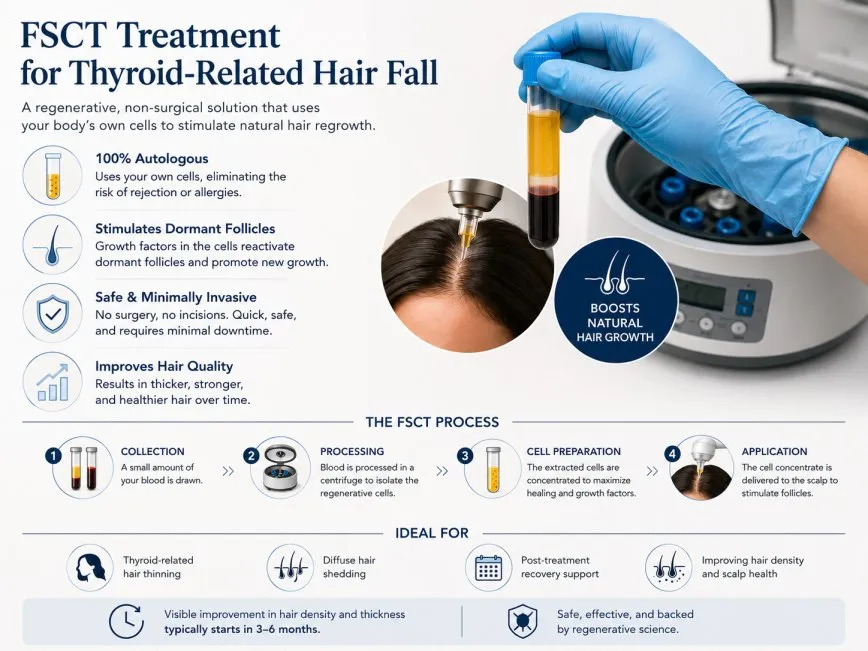
Why FSCT is relevant for persistent thyroid hair loss:
- Prolonged thyroid imbalance can cause follicles to remain in the resting phase even after hormones normalise
- PRP and minoxidil stimulate follicle activity but FSCT goes a step further by reactivating follicles that have not responded to those approaches
- FSCT is most effective in patients who have already stabilised their thyroid levels and nutritional status
Who is FSCT suited for with thyroid hair loss?
- Patients who have been on stable thyroid medication for 6+ months but are still not seeing the density they expected
- Those with diffuse thinning across the scalp that is not recovering despite optimised ferritin, selenium, and zinc levels
- Anyone who has tried PRP or minoxidil without adequate results
FSCT is available at Radiance Skin Antiaging and Hair Transplant Clinic under the guidance of Dr. Nitin Barde. A consultation includes a detailed scalp assessment and blood work to confirm whether you are a suitable candidate before any treatment is recommended.
Frequently Asked Questions
Q How do I know if my hair loss is from my thyroid?
Thyroid hair loss typically presents as diffuse, all-over thinning rather than patchy loss or a receding hairline. It often appears alongside other thyroid symptoms: fatigue, weight changes, temperature sensitivity, or mood shifts. A blood panel including TSH, T3, T4, and ferritin is the most reliable way to confirm the connection.
Q Will my hair grow back after thyroid treatment?
For most people, yes. Thyroid hair loss is non scarring, which means the follicles are not permanently damaged. Once hormone levels normalise and any nutritional deficiencies are corrected, hair typically begins to recover. The process takes several months, usually 6 to 12 from when treatment begins.
Q How long does it take for hair to grow back after thyroid treatment?
Early regrowth usually begins within 3 to 6 months of stable thyroid hormone levels. Noticeable improvement in density and texture tends to follow at the 6 to 12 month mark. Full recovery can take up to a year, depending on the individual and how early treatment was started.
Q What nutrients help with thyroid hair loss?
Iron (ferritin), selenium, zinc, and protein are the most important. Deficiencies in these nutrients are commonly found alongside thyroid disorders and independently contribute to shedding. Getting levels tested before supplementing is recommended, as over supplementing some nutrients can be counterproductive.
Q Can stress make thyroid hair loss worse?
Yes. Chronic stress raises cortisol, which suppresses thyroid function and pushes hair follicles into the shedding phase compounding the effect of thyroid imbalance. Managing stress through sleep, movement, and stress-reduction practices is a meaningful part of supporting hair recovery.
Q Should I take biotin for thyroid hair loss?
Biotin (vitamin B7) is widely marketed for hair loss but has limited evidence for thyroid-related shedding specifically. It’s worth noting that high-dose biotin can also interfere with thyroid blood test results, so discuss it with your doctor before adding it to your routine.
Conclusion
Thyroid-related hair loss can feel disheartening especially when you’re already managing the fatigue, brain fog, and other challenges that come with a thyroid condition. But the hair loss itself is almost never the end of the story.
The most important thing you can do is treat the root cause. No topical product or supplement will substitute for correctly managed thyroid hormone levels. Once those are stable, your hair follicles have the conditions they need to recover and most of them will.
In the meantime, support your recovery with good nutrition, gentle hair care, and a little patience with your body’s timeline. If progress stalls or you’d like a more personalised approach, specialist support is available and earlier is better than later.
For a comprehensive evaluation of your hair and thyroid health, visit Radiance Skin and Hair Clinic. The team specialises in root-cause diagnosis and personalised hair treatment plans that work with not around your medical picture.
Not Sure What’s Causing Your Hair Loss?
The earlier you identify the cause, the easier it is to treat.
Get a personalized diagnosis and expert guidance tailored to your condition.
Book a consultation with Radiance Clinic to get 10% off with promocode HAIRLOSS10